Dual EV Household: The Smarter, Safer Way to Share One Home Charger (Tesla & J1772)
So, you’ve done it. You’ve officially become a two-plug family. Maybe there’s a sleek Tesla Model Y in the driveway for the commute, and a rugged Ford Mustang Mach-E or a Rivian R1S in the garage for the weekend hauls. It’s the 2026 dream—zero trips to the gas station, ever again.
But then reality hits when you look at your electrical panel.
I’m Alex Reynolds, and over the last 15 years, I’ve seen everything from melted fuse boxes to “hacked” charging cables that look like a fire waiting to happen. As the lead technical expert here at BestEVAccessories.com, my mission is simple: I torture-test EV gear so you don’t have to. I check for thermal stability, copper gauge quality, and whether those “safety certifications” on the box are actually worth the ink they’re printed with.
Today, we’re tackling the “Dual EV Dilemma.” You’ve got two different plugs (NACS and J1772), but you probably only have room for one high-voltage circuit. I’m going to show you how to save thousands of dollars by sharing a single charger without burning your house down.
The Double-Charger Headache: Why Two Isn’t Always Better
When people bring home a second EV from a different brand, their first instinct is often to call an electrician to install a second Level 2 wall charger. Before you pick up that phone, let’s look at the “hidden” costs of that move in 2026:
- The Electrical Panel Crunch: Most modern homes have a 200-amp service. Adding a single 50-amp or 60-amp circuit for one EV is fine. Adding a second one? You might exceed your panel’s capacity, leading to a mandatory (and expensive) service upgrade that can cost upwards of $3,000 to $5,000.
- The Garage Clutter: Two bulky charging units and two 25-foot cables snaking across the floor is a tripping hazard and an eyesore.
- Installation Labor: Wiring a second dedicated line through finished drywall isn’t cheap. You’re paying for permits, copper wire (which isn’t getting any cheaper), and labor.
The “Dual EV household charger” problem isn’t just about the plug—it’s about efficiency. In 2026, the smartest move is to install one high-powered Tesla Wall Connector and use a high-quality bridge for your non-Tesla vehicle.
The Solution: One Tesla Charger to Rule Them All
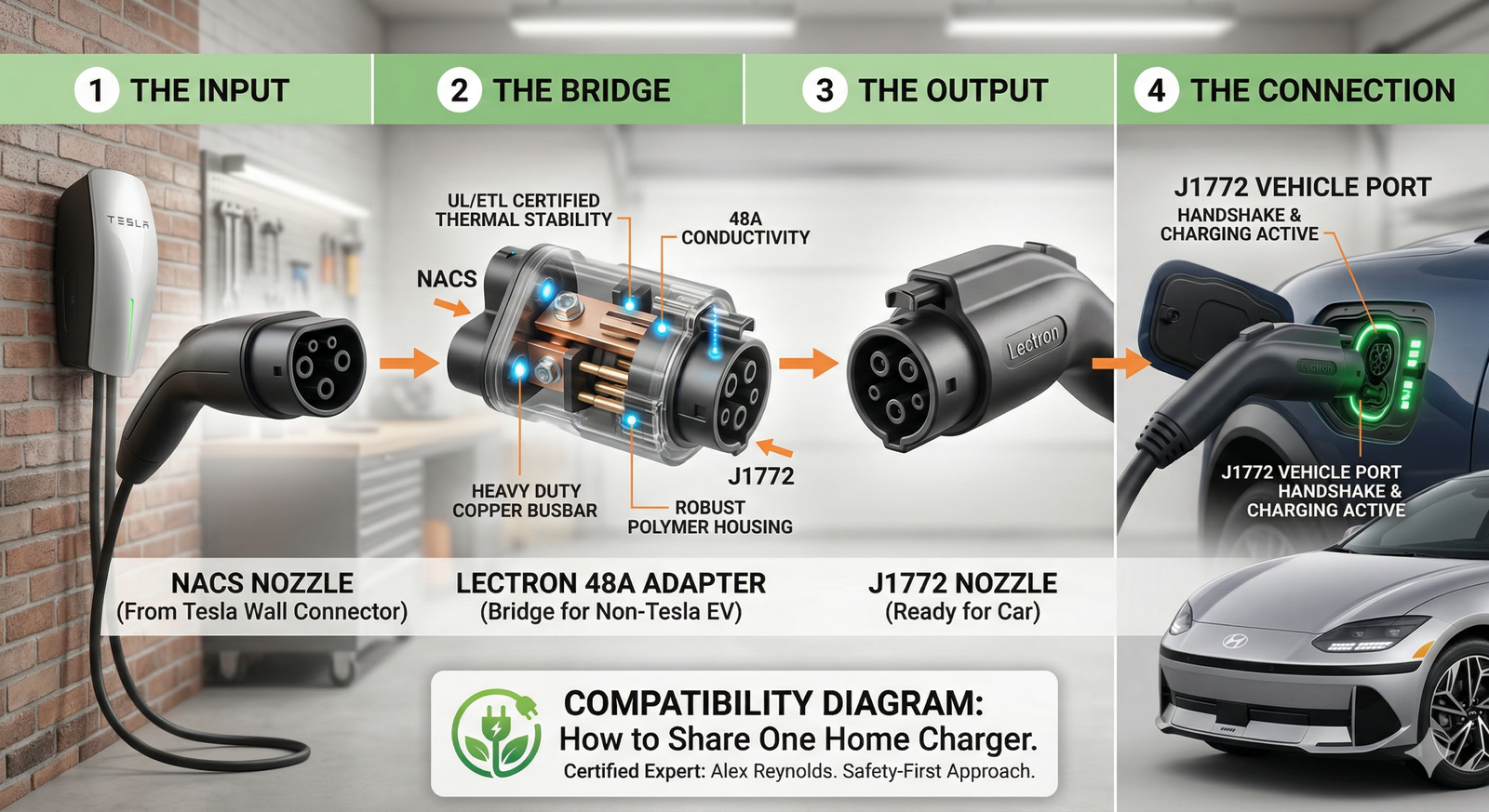
Why start with a Tesla charger? Simple. The Tesla Wall Connector is widely regarded by technicians like myself as one of the most reliable, compact, and “smart” units on the market. It’s capable of delivering up to 48 Amps of power, which is the “sweet spot” for Level 2 home charging.
But how do you get that Tesla NACS plug into your Ford, Chevy, or Hyundai’s J1772 port?
Product Spotlight: The Lectron Tesla to J1772 Adapter (48A Edition)
In my lab, I’ve put dozens of adapters through “hot-box” testing. Most of them fail when pushed to 48A for more than two hours. The Lectron Tesla to J1772 Adapter is the rare exception that I actually feel comfortable recommending to my own family.
Why this is the ultimate garage hack:
- True 48A Capacity: Many cheap adapters claim they can handle high power, but they throttle the speed or overheat. The Lectron is built to handle the full output of a Tesla Wall Connector.
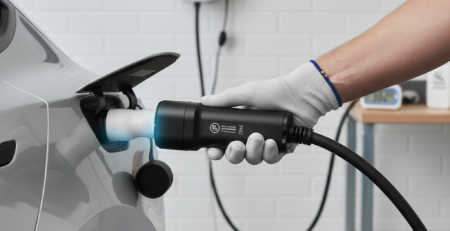
- Seamless Integration: You simply snap the adapter onto the Tesla cable, wait for the “handshake,” and plug it into your J1772 car. It turns your Tesla charger into a universal station.
- Space Saving: Instead of two units, you have one sleek setup. When you’re done charging the Ford, you pull the adapter off and plug the Tesla back in.
![J1772 Charger Adapter Compatible Tesla Model 3/Y/X/S[Security Check ] 80 Amp / 240 AC-Compatible with SAE J1772 Charger[Only for Tesla Car]](https://m.media-amazon.com/images/I/41umZmXI9bL._SS520_.jpg)
🔥 Special Deal: If you’re upgrading your home setup, remember you can get a 10% OFF discount on this Lectron adapter when paired with any Level 2 charger directly at BestEVAccessories.com. It’s the best way to future-proof your garage while keeping some cash in your pocket.
Technical Deep Dive: Safety and Thermal Stability
Let’s talk shop for a second. Why am I so obsessed with “Safety-First” gear?
When you charge an EV at home, you are pulling a massive amount of electricity through a small point of contact for 8 to 10 hours straight. This creates heat. A poorly made Tesla to J1772 adapter is a massive fire hazard because of three specific failure points:
1. The “Heat Sink” Effect
Low-quality adapters use thin internal wiring or hollow pins. Under a 48A load, these pins act like a toaster element. A technician-approved adapter like the Lectron uses solid, high-conductivity copper that dissipates heat into the surrounding air rather than trapping it against your car’s expensive charge port.
2. UL and ETL Certifications
I cannot stress this enough: Never buy an uncertified EV adapter. If it doesn’t have a UL (Underwriters Laboratories) or ETL stamp, it hasn’t been tested for flame retardancy or electrical arcing. In my years of vehicle electronics experience, I’ve seen uncertified plastic housings literally drip like candle wax during a high-amperage charging session.
3. Mechanical Latching
A loose connection is a dangerous connection. High-quality adapters have a tactile “click” when they lock onto the Tesla cable. This ensures the pins are perfectly aligned. If the pins are misaligned by even a fraction of a millimeter, you get “arcing”—micro-sparks that degrade your car’s hardware over time.
Organizing Your EV Garage Setup for 2026
If you’re setting up a dual EV household, here is my recommended workflow for maximum efficiency:
- Mount the Charger Centrally: Install your Tesla Wall Connector between the two garage bays. This ensures the 24-foot cable can reach the charge ports of both cars, whether they are on the front-left or rear-right of the vehicle.
- The “Dedicated Adapter” Strategy: I always tell my clients to leave the Lectron adapter attached to the car that needs it, or keep it on a dedicated hook next to the charger. This prevents the “Where did I put the plug?” scramble at 6:00 AM.
- Smart Scheduling: Use the “Scheduled Charging” feature in your vehicle’s app. Set the Tesla to charge from midnight to 4:00 AM, and the non-Tesla to charge from 4:00 AM to 8:00 AM. This prevents you from ever having to “swap” cables in the middle of the night.
The “Alex Reynolds” Final Verdict
Sharing one charger isn’t just about saving money on an electrician; it’s about making your life simpler.
Installing a second charger is often overkill. With a single high-quality Tesla unit and a Lectron EV adapter review-verified bridge, you get the best of both worlds. You get the reliability of Tesla’s hardware and the flexibility to drive whatever EV you want.
However, please—from one car guy to another—don’t skimp on the safety. Your EVs are likely the second most expensive things you own after your house. Don’t risk them on a $30 “no-name” adapter from a random marketplace. Stick to certified gear that has been tested for thermal stability and high-amperage loads.
Saving money on your EV garage setup 2026 is smart. Doing it safely is even smarter.
Stay safe on the road, and keep those batteries balanced!
Need help choosing the right cable length or mounting hardware? Drop a comment below, and I’ll get back to you with the technical specs.
Alex Reynolds Lead Technician, BestEVAccessories.com
J1772 Charger Adapter Compatible Tesla Model 3/Y/X/S[Security Check ] 80 Amp / 240 AC-Compatible with SAE J1772 Charger[Only for Tesla Car]
Features
| Part Number | t001 |
| Model | JT2 |
| Warranty | 1 |
| Color | Black |
- ⚡ Works with Tesla charger adapter designed to connect the SAE J1772 chargers to your Tsl vehicle. With our adapter, Tsl drivers can utilize J1772 charging stations.
- ⚡ Maximize the EV charging options of your Model 3/Y/S/X. The adapter enables compatibility with Level 1 and Level 2 charging stations, greatly increasing the number of charging destinations for your Tsl.
- ⚡ 240V AC, 50-60Hz, 80A Max. With an operating temperature of -22°F to 122°F (-30°C to 50°C).
- ⚡ Simply connect the adapter to the SAE J1772 charger, then connect to your Tsl vehicle.
- ⚡ The adapter is suitable for charging outdoors.
- ⚡To determine if your vehicle is compatible,or contact Tsl.
- Security check
- Please use qualified charging equipment to avoid melting of converter head due to high temperature.