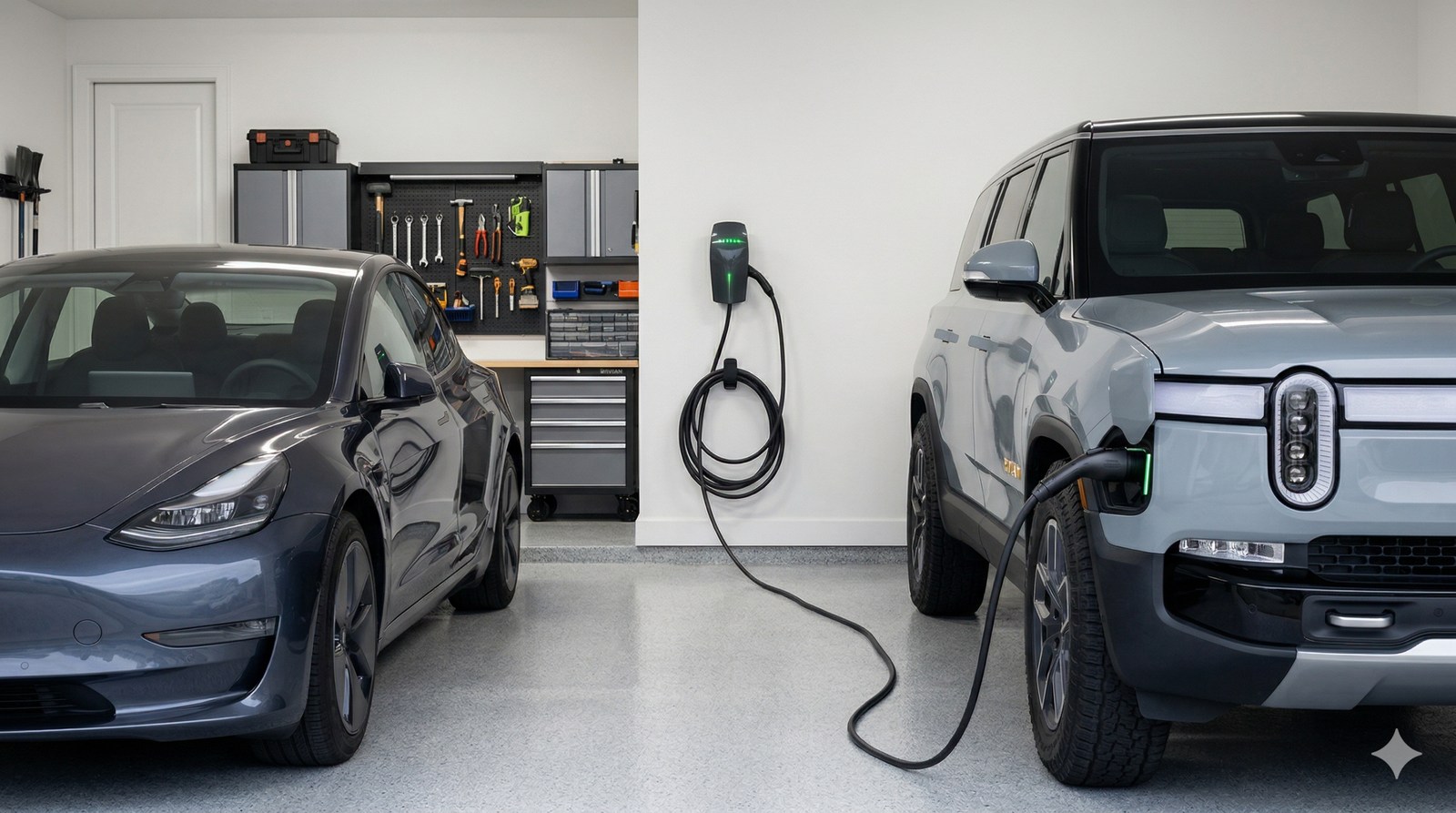
Dual EV Households: How to Share One Charger for Tesla and Non-Tesla
It’s becoming the new “normal” in American driveways: a Tesla Model 3 for the commute and perhaps a Ford Mustang Mach-E or a Rivian R1S for the weekends. While owning two electric vehicles is great for the environment, it often leads to a logistical headache in the garage.
Do you really need to spend thousands of dollars installing two separate Level 2 chargers? The short answer is no. With the right strategy and safety-vetted gear, you can easily share a single charging station between different brands. Here is how to do it without compromising your home’s electrical safety.
The Logic of the Single-Charger Setup
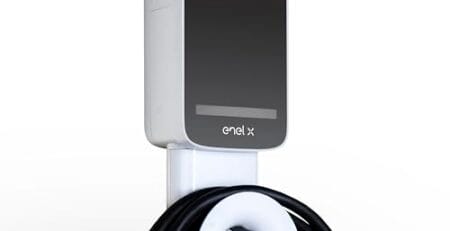
Most EVs sit idle for 10 to 12 hours overnight. Even with two cars, a single high-quality Level 2 charger—like a JuiceBox 32A or a Tesla Wall Connector—usually provides more than enough “juice” to top off both batteries if you manage your timing.
However, the challenge lies in the plugs. Tesla uses the North American Charging Standard (NACS), while most other EVs (until very recently) used the J1772 port.
Expert Insight: Efficiency Meets Safety
Hi, I’m Alex Reynolds. With 15 years in vehicle electronics, I’ve seen homeowners try to “daisy-chain” cheap adapters to make this work. Don’t do it. The EV market is currently flooded with uncertified clones that pose fire risks. When sharing a charger between two different standards, every connection point must be vetted for thermal stability and UL/ETL certification.
Two Ways to Share the Power
Option 1: The Tesla-Primary Setup
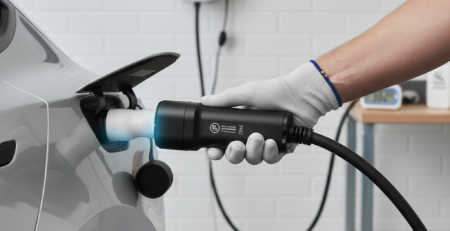
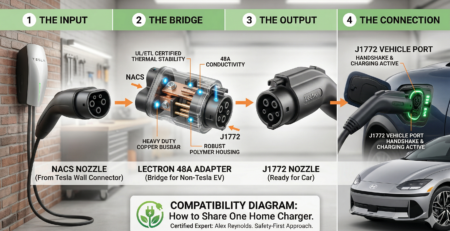
If you already have a Tesla Wall Connector installed, you can charge your non-Tesla EV by using a high-quality adapter like the Lectron Tesla to J1772 Adapter.
- The Benefit: Tesla chargers are famously reliable and sleek.
- The Safety Check: Ensure the adapter is rated for the amperage of your charger (usually 48A) to prevent overheating.
Option 2: The J1772-Primary Setup
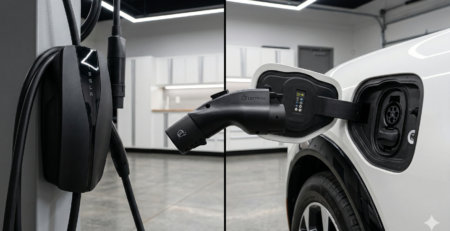
If you use a standard J1772 Level 2 home charger, your Tesla already came with a small NACS adapter.
- The Benefit: J1772 is the universal “public” standard, making the charger versatile for guests.
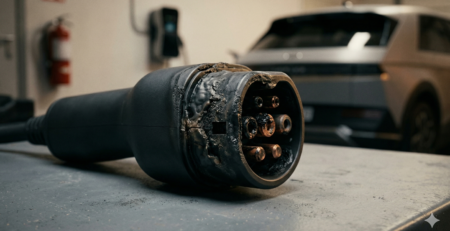
- The Safety Check: These small adapters are easy to lose or drop. Always inspect the pins for arc damage before plugging them into your Tesla.
Alex’s Pro-Tips for Dual Charging
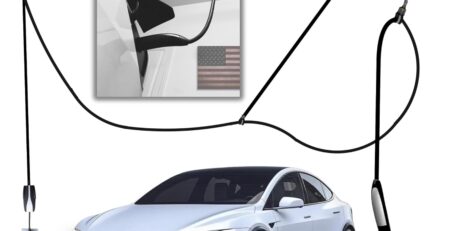
- Prioritize Cable Management: When sharing one cord between two cars, the cable often gets dragged across the floor. Use a Heavy-Duty J-Hook or wall mount to keep the cable off the ground and prevent it from being run over.
- Stagger Your Charging: Use your vehicle’s app to schedule charging. Have the first car charge from 9:00 PM to 1:00 AM, and the second from 1:00 AM to 5:00 AM. This prevents “tripping” your home’s main breaker if other heavy appliances are running.
- Check the Heat: Under high-amperage loads, feel the adapter and the plug. If it’s too hot to hold comfortably, your adapter might have poor heat dissipation or poor internal cable gauge quality.
Frequently Asked Questions (FAQ)
1. Can I charge both cars at the exact same time with one charger?
Only if you use a specific “Dual Head” charger designed to split power. Using a standard “Y-splitter” on a single-head charger is extremely dangerous and is a major fire hazard.
2. Is the Lectron Tesla to J1772 adapter safe for overnight use? Yes, the Lectron adapter is a trusted choice in the EV community, supporting up to 48A. However, always ensure it is fully seated and “clicked” into place to maintain thermal stability.
3. Will sharing a charger wear out my EV’s charging port faster?
No. EV ports are designed for thousands of cycles. As long as you aren’t forcing the adapter or letting the heavy cable put “leverage” on the port, there is no increased wear.
4. My non-Tesla says “Charging Paused” when using the Tesla adapter. Why?
This is often a communication handshake issue. Try plugging the adapter into the Tesla cable first, waiting 30 seconds, and then plugging the whole assembly into your non-Tesla vehicle.
5. Do I need a smart charger to manage two cars? It helps, but it isn’t required. Smart chargers like the JuiceBox allow you to track energy usage for each car separately, which is great if you want to see exactly how much each vehicle is costing you in electricity.